
What do official government advisories say about travel to Ukraine?
Most Western governments maintain a firm "do not travel" advisory for Ukraine, because of ongoing missile strikes and the unpredictable security situation. These warnings are updated regularly and apply to all regions, though the specific language and risk ratings vary by country.
Major foreign ministries warn that civilian infrastructure remains a target and embassies can offer very limited consular help inside Ukraine. You should check the advisory from your own government immediately before making any plans, as the situation can shift within hours.
- The US Department of State (updated May 2024) assigns Ukraine a Level 4: Do Not Travel rating, citing Russia's full-scale invasion and the risk of harassment aimed at US citizens.
- The UK Foreign Office advises against all travel to Ukraine, with its latest update in June 2024 reinforcing the threat of frequent explosions and missile debris in city centers.
- Canada's travel advisory (June 2024) warns citizens to avoid all travel to Ukraine, highlighting the volatile security situation and the risk of lethal attacks across the country.
- The European Union, via its member states' coordinated advisories, uniformly recommends against non-essential travel, with France and Germany echoing the high-threat assessment in their mid-2024 updates.
Which regions of Ukraine are the most dangerous right now?
The highest risk is concentrated along the active frontline in the east and south. Donetsk, Luhansk, and significant parts of Zaporizhzhia and Kherson oblasts see constant shelling and ground combat. Civilians cannot enter these areas without special military permission. The threat from artillery, drones, and landmines is constant.
A second high-risk band covers regions bordering russia and belarus. Sumy, Kharkiv, and Chernihiv oblasts face frequent cross-border shelling and missile attacks with very short warning times. The city of Kharkiv, while not on the immediate frontline, remains a regular target for guided aerial bombs and has a curfew that starts earlier than in other major cities. The northern border zone is heavily militarized and closed to casual visitors.
Cities deep inside the country face a different risk profile. Kyiv, Odesa, Dnipro, and Lviv are targeted by long-range drone and missile strikes, but the frequency varies. Air defenses around the capital are dense, which reduces the hit probability. The western oblasts, including Zakarpattia, Ivano-Frankivsk, and Chernivtsi, experience the lowest number of attacks and serve as the primary hub for international organizations and humanitarian operations.
- Active combat zones: Donetsk, Luhansk, parts of Zaporizhzhia and Kherson. No civilian access.
- Border danger zone: Sumy, Kharkiv, Chernihiv oblasts. Regular cross-border strikes, heavy military presence.
- Frequently targeted cities: Kyiv, Odesa, Dnipro, Kharkiv. Missile and drone attacks with air raid alerts.
- Lower-risk west: Zakarpattia, Ivano-Frankivsk, Chernivtsi, Ternopil. Fewer strikes, functioning logistics.
- Crimea: occupied territory with active military infrastructure. Dual risk of strikes and Russian security forces.
What are the rules for curfews and air raid shelters?
A curfew is a legal restriction on movement, not a recommendation. A typical nightly curfew runs from midnight to 5:00 a.m., but the exact hours vary by region and city. In frontline areas such as Kharkiv or Zaporizhzhia, the curfew can start as early as 9:00 p.m. and end later in the morning. During these hours you must stay indoors or inside a shelter. If you are on the street without a special pass, the police may detain you and check your documents.
You must go to the nearest shelter when an air raid siren sounds. You will hear the siren on your phone if the government alert app is active, and from loudspeakers in cities. Shelters are marked with signs that read "Укриття" and include metro stations, underground parking lots, and basements of public buildings. Do not ignore the siren even if you see locals staying outside; the threat of ballistic missile fragments is real across the whole country.
In practice, you need to plan your day around the curfew. Check the official city administration website for the exact times when you arrive. Download the Air Alert app linked on the State Emergency Service website and keep your phone charged. When you check into a hotel, ask the staff to point out the shelter entrance and the fastest route from your room. Carry your passport and a small bag with water, a power bank, and a warm layer at all times, so you can move to a shelter immediately without going back to your room.
How do I move around the country safely?
Ukraine’s airspace remains closed to civilian flights, so your journey starts at a land border crossing from Poland, Slovakia, Hungary, Romania or Moldova. From there, the national railway, Ukrzaliznytsia, is the most reliable way to travel long distances. Trains run frequently between major cities like Kyiv, Lviv, Odesa and Dnipro, and overnight sleeper cars let you cover ground while a curfew is in effect. Buy tickets through the official app or website, as paper tickets slow you down at stations.
Road travel is less predictable. Highways are generally in fair condition, but you risk encountering military convoys, sudden checkpoints and unexploded ordnance in areas that saw fighting. If you drive, stick to daylight hours, keep your documents within reach and never photograph military equipment or personnel. Ridesharing apps like Bolt and Uklon work in cities. Intercity buses are a practical fallback where trains are fully booked.
- Use the Ukrzaliznytsia app to book train tickets in advance and check for schedule changes.
- Plan all road trips for daylight hours only and confirm the route with a local contact before you leave.
- Avoid any road marked with military signage, temporary barriers or unexploded ordnance warning signs.
- At a checkpoint, turn on the interior light, keep your hands visible and follow the officer’s instructions without argument.
- Carry your passport, visa and a printed copy of your travel insurance at all times.
- Download offline maps in your navigation app, as mobile networks can be disrupted without notice.
What kind of travel insurance works in a war zone?
Standard travel insurance policies do not cover losses caused by war, civil unrest, or acts of terrorism. If you enter Ukraine with a regular policy and get injured in a missile strike, the insurer will reject your claim. You need a specialized war risk or high-risk zone insurance product that covers medical treatment, emergency evacuation, and repatriation in an active conflict area.
Several international providers now offer such policies for Ukraine. They typically cover inpatient and outpatient care, ambulance transport, and medical evacuation to a neighboring country or your home state. Some also include coverage for shrapnel wounds, blast injuries, and emergency dental treatment. The policy document states a maximum coverage amount per person, usually with a deductible you pay out of pocket before the insurer covers the rest.
Check these features before you buy a war zone policy:
- Whether the policy covers injuries from direct combat action, not just collateral incidents
- The geographical limits of coverage, since some policies exclude frontline regions entirely
- The evacuation trigger, meaning how severe an injury must be before the insurer arranges transport
- Pre-existing condition exclusions that might apply even in an emergency
- Payment terms, including whether the insurer pays the hospital directly or reimburses you later
- The 24-hour assistance hotline number and the languages its operators speak
Purchase the policy before you cross the Ukrainian border. Insurers rarely sell coverage to travelers already inside the country. Keep the policy number and the emergency contact saved on your phone and on a paper slip in your bag, since mobile networks can go down during air raids.
What practical steps can I take to reduce risk?
Focus on a few repeatable habits rather than trying to plan for every scenario.
- Register your trip with your home country's embassy or consulate before you arrive. This puts you on a contact list for emergency alerts and evacuation coordination.
- Download the Air Alert app on your phone and keep notifications on. The app gives you a region-specific warning the moment an air raid siren activates, often faster than the outdoor sirens.
- Carry your passport, visa documents and a printed copy of your travel insurance policy at all times. A digital backup on your phone and in cloud storage adds a second layer of security.
- Identify the nearest shelter as soon as you check into a hotel, an apartment or a coworking space. Walk the route once so you can find it in the dark or without a phone signal.
- Agree on a backup communication plan with one contact outside Ukraine. Pick a messenger app that works on minimal bandwidth and set a twice-daily check-in time.
These steps do not eliminate risk, but they reduce the confusion that makes an emergency harder to manage.
Frequently asked questions
Is any part of Ukraine completely safe for tourists now?
No part of Ukraine is completely safe. Even cities far from the front line, such as Lviv or Uzhhorod, are regularly targeted by missile and drone attacks. The risk of an air raid can occur anywhere in the country, and all visitors must follow shelter protocols.
Can I fly directly into Ukraine?
No. Ukrainian airspace has been closed to all civilian flights since February 2022. You must enter by land from a neighboring country such as Poland, Slovakia, Hungary, Romania, or Moldova, with train travel from Poland being the most common route.
Will my government evacuate me if the situation gets worse?
Most governments, including the US and UK, have made it clear they will not perform military evacuations of private citizens from Ukraine. You are responsible for your own safety and departure, and consular services on the ground are extremely limited.
Do I need special permission to visit areas near the front line?
Yes. Travel to regions close to active hostilities is heavily restricted. You need special permits from military or civil authorities, and visiting these areas without permission is illegal and extraordinarily dangerous due to shelling, mines, and unexploded ordnance.
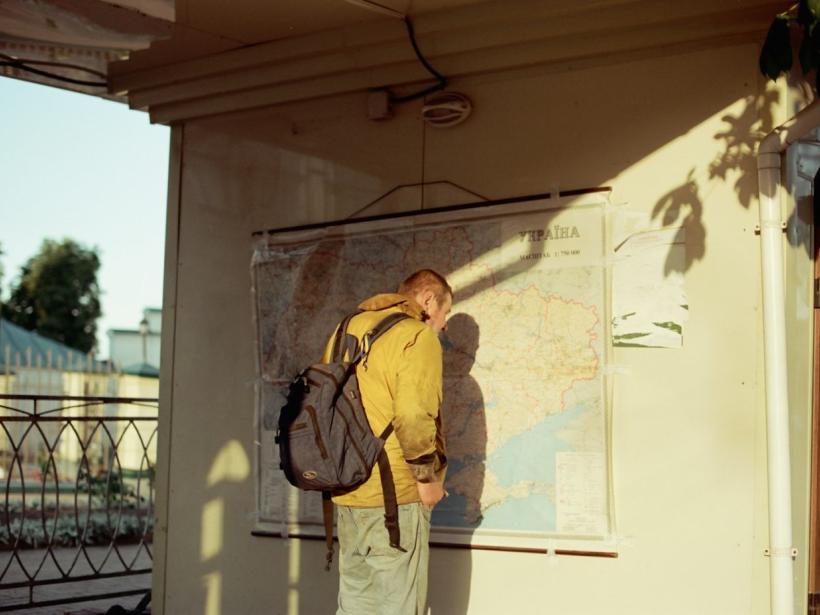
Photo: Andrew Lvov, Unsplash (Unsplash License)