
Does a child need their own passport to travel abroad?
Yes. A child of any age, including a newborn, must have their own international passport to leave Ukraine for most countries. The only exception applies to children added to a parent's old-style non-biometric passport before 2018. Those entries remain valid only until the parent's passport expires, and the child can travel on that document only when accompanied by that specific parent.
Ukrainian law now provides two types of international passports for children. The biometric passport contains an embedded chip with the holder's photo and fingerprints. Children aged 12 and older must submit fingerprints when applying. For younger children, the chip stores only the digital photo. The older non-biometric version has no chip and is issued as a paper booklet with a pasted photo.
How long it takes depends on where you apply. A standard application through the State Migration Service takes up to 20 working days. An expedited application at a passport service center takes 7 working days. The biometric passport for a child under 16 is valid for 4 years. The non-biometric version is valid until the child turns 16.
When is a birth certificate required?
A birth certificate proves the family relationship between a child and the adult they travel with. Border officers ask for it mainly when the child and the parent have different surnames. The same rule applies to grandparents or other relatives who accompany a minor. Without this document, officers cannot confirm that the adult has the right to cross the border with the child.
Airlines have their own check-in rules. Many carriers require a birth certificate for any child under 18 who travels with an adult, regardless of matching surnames. Staff check the document at the check-in desk before issuing a boarding pass. You should carry the original paper copy, not a photo on your phone.
If the birth certificate is not in English or the official language of the destination country, you need a certified translation. A notary or a sworn translator prepares the translation to accompany the original. Without it, foreign border officers may reject the document and refuse entry.
When do you need a notarized consent from the other parent?
A notarized consent from the second parent is mandatory when a child under 18 crosses the border with only one parent or with a third party such as a grandparent, coach, or family friend. Border officers in Ukraine and most destination countries will ask for this document if both legal guardians are not present. Without it, border officers can deny the child exit.
You must get the consent notarized in Ukraine or at a Ukrainian consulate abroad. The document needs to state specific details to be valid at passport control. Carry the original, not a copy. You will often need a translation into English or the language of the destination country.
- The child’s full name, date of birth, and passport details.
- The accompanying adult’s full name, date of birth, and passport number.
- The destination country or countries and the travel dates or period.
- A clear statement that the second parent gives permission for the specific trip.
- The second parent’s contact information and signature, certified by a notary.
A one-time consent covers a single trip with fixed dates and a named destination. You can get a multi-trip consent for up to three years. It allows repeated visits to one or more listed countries without a new document each time. The multi-trip option suits families where one parent regularly takes the child abroad for holidays or competitions. Always check with the destination’s embassy whether they accept a multi-trip consent. Some states require a fresh notarized document for each entry.
What are the document rules for a child traveling alone or with an airline escort?
When a child flies without a parent, airlines take on a formal supervisory role through their unaccompanied minor service. This service is typically mandatory for children aged 5 to 12 on direct flights, and often required up to age 14 or 16 on connecting itineraries. You cannot simply buy a ticket and send a young child through security alone; the airline acts as a temporary guardian from check-in until the child is handed to the designated pickup person at the destination.
You must complete a detailed unaccompanied minor form at the check-in counter. This document collects the full names, addresses, and phone numbers of the parent or guardian dropping off the child and the adult authorized to collect them at arrival. The pickup person must show government-issued photo identification, and their name must match the form exactly. A parent or guardian is also required to stay at the airport until the flight has departed.
Standard document kits for a child flying solo include these items:
- The child's own valid passport, and a visa if required by the destination country.
- A notarized consent letter signed by both parents, specifically stating the travel dates and the adult meeting the child.
- A copy of the birth certificate to confirm the child's legal guardians.
- The completed unaccompanied minor form, which the airline keeps on file and a copy travels with the child.
- Copies of the pickup adult's passport or national ID, often attached to the airline paperwork.
Children aged 16 to 18 are generally allowed to travel alone on most carriers without the formal escort service, but they still need the full set of parental consent documents for border control. Some airlines extend the mandatory escort age to 17 for complex routes, so you should check the carrier's specific policy before booking the ticket.
Do different countries have extra entry rules for children?
Many countries impose additional documentation requirements for minors that go beyond a standard passport check. A child may need a visa even when the accompanying adult enters visa-free, and birth certificates often require a certified translation with an apostille stamp to be accepted by foreign border officers.
The Schengen area is a common example. A minor traveling without both parents typically needs a notarized consent letter translated into the language of the destination country, and border guards may ask for a copy of the absent parent's passport data page. Turkey and Egypt frequently require a separate visa for a child traveling on their own passport, and the child's photo must be recent and clearly identifiable. Some countries, including South Africa, enforce strict rules requiring an unabridged birth certificate listing both parents, and you may be denied entry without it.
Rules change without much notice, so verify the specific entry requirements for your destination on the official embassy website or the foreign ministry's portal before you book. The IATA Travel Centre also provides a reliable summary of document rules for every route.
What documents does a child need for domestic flights and train travel?
For domestic travel within Ukraine, the rules are simpler than for international trips, but they still depend on the child's age. A child under 14 can board a domestic flight using only their birth certificate. You do not need a notarized consent from the other parent for travel inside the country.
Once a child turns 14, a Ukrainian internal passport or an ID card becomes the required document for domestic flights. Train travel follows a similar pattern, though conductors often accept a student ID card in place of a birth certificate for older children. Always check with the specific carrier before you travel, as enforcement can vary.
- A child under 14 can fly domestically with an original birth certificate.
- A child aged 14 and older must present a Ukrainian internal passport or ID card.
- For train travel, a student ID card may substitute for a birth certificate for teenagers.
- Parental consent is not required for domestic flights or train journeys within Ukraine.
- If the child’s surname differs from yours, carry a document that proves your relationship.
- Some airlines ask for a birth certificate even for infants traveling on a parent’s lap.
Frequently asked questions
Can a child travel abroad with only one parent without a notarized consent?
Yes, but only if the second parent has not formally objected. Ukrainian law allows a child to leave the country with one parent for up to one month without a notarized consent, provided the other parent has not submitted a written objection to the State Border Guard Service. However, airlines and the destination country may still demand the consent, so it is safer to carry one.
How long is a notarized parental consent valid?
The validity period is stated in the document itself. A one-time consent usually covers a specific trip with exact dates, while a multi-trip consent can be issued for one, two, or three years. The consent must specify the destination country or state that it is valid for all countries.
Does a child need a separate visa if they are in the parent's passport?
Most countries now require every traveler to have their own passport and visa, regardless of age. If a child is still entered in a parent's old non-biometric passport issued before 2018, some countries may issue a visa in that passport, but this practice is disappearing. Check with the embassy of your destination.
What if the child's surname differs from the parent's?
You must carry the child's birth certificate to prove the relationship. Border officers and airline staff will check it. If the certificate is in Ukrainian or Russian, get a certified translation into English or the language of the country you are visiting. An apostille may also be required for countries outside the Hague Convention.
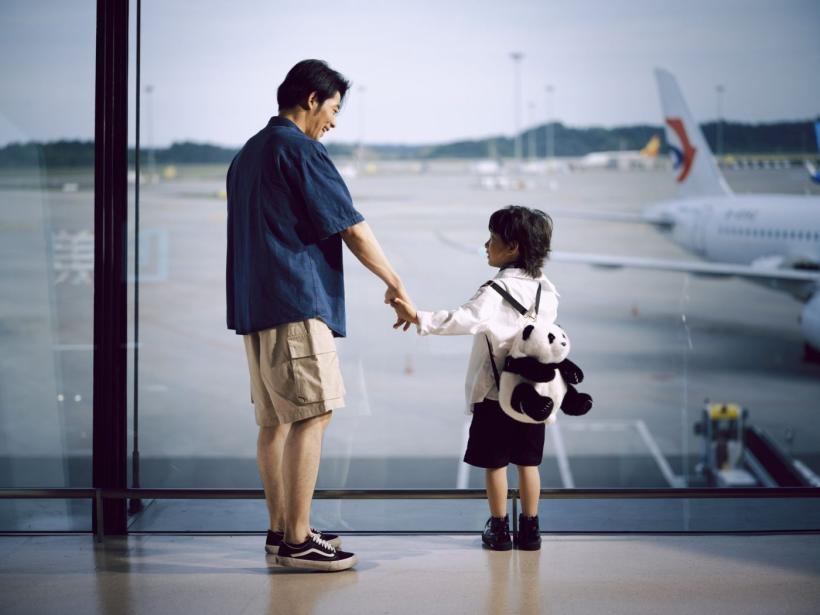
Photo: Gatsby Yang, Pexels (Pexels License)