
What do official travel advisories say about Morocco?
The UK Foreign Office (FCDO) and the US State Department both updated their Morocco advice in early 2026. They agree that most of the country is safe for tourists who stick to major cities and established routes, but a heightened risk of terrorism applies nationwide. The FCDO warns that attacks could happen anywhere, including places visited by foreigners, while the US advisory, last refreshed in January 2026, keeps Morocco at Level 2 (exercise increased caution) due to the same threat.
Both governments explicitly tell their citizens to avoid all travel to the Western Sahara border region and to stay within 30 km of the main road when visiting areas south of the Atlas Mountains. The Australian government's Smartraveller service issued its latest update in late 2025 and mirrors this position, adding a reminder that demonstrations over regional issues can flare up without notice in larger cities. None of the three advisories singles out tourist hubs such as Marrakech, Fes or Essaouira as no-go zones.
Which areas of Morocco should tourists avoid?
The UK FCDO, as of early 2026, advises against all travel to the area within 30 km of the Western Sahara border, specifically the Berm, due to the risk of unexploded landmines and military activity. The US State Department echoes this warning, noting that the border zone with Algeria, particularly in the provinces of Figuig and eastern Errachidia, carries a higher risk of cross-border terrorism and smuggling operations.
Similarly, the Mauritanian border region south of the Berm sees very limited government presence. These remote desert areas have no reliable phone signal or emergency services, so any incident becomes hard to manage. Stick to major highways and well-known tourist routes, and always check the latest advisory map from your own government before planning a desert excursion.
- The 30 km-wide strip along the Western Sahara Berm is closed to tourists due to ongoing military presence and landmines.
- Remote eastern provinces bordering Algeria, away from the main N13 and N17 highways, are flagged for terrorism risks.
- The far southern desert zone near Mauritania has minimal police patrols and no reliable phone signal.
- Informal border crossings into Algeria or Mauritania are not open to regular travellers and can be dangerous.
- Military zones in the south are clearly marked on official maps and are strictly off-limits.
- Urban areas like Marrakech, Fez and the coastal cities remain outside these advisory zones and see heavy tourist police presence.
What are the most common scams and petty crimes?
Petty crime, not violent assault, is the main risk for visitors in Morocco. The UK FCDO notes that pickpocketing, bag snatching and scams are common in busy medinas, souks and around transport hubs, especially after dark. Stay alert in the narrow alleys of Fes and Marrakech, where a moment’s distraction can mean a missing phone or wallet.
Scammers often act friendly to lower your guard. A firm but polite “no, thank you” as you walk away stops nearly every con before it starts. Keep a copy of your passport with you and lock the original in your accommodation safe, and only carry the cash you plan to spend that day.
- Fake guides and “tanneries are closed.” Someone will offer to show you the way, then demand a steep fee or lead you to a shop where prices are inflated to cover his commission. Official guides always carry a badge and are booked through a licensed agency or your hotel.
- The “wrong direction” hustle. A local tells you your riad, restaurant or attraction is closed or blocked, and offers to take you somewhere else. The destination will be a shop or a café where you are pressured to buy. Check the route on your phone and keep walking.
- Overcharging and menu tricks. A menu with no prices, or a verbal quote that triples when the bill arrives. Agree on a price before you order anything in a market stall or a street café, and check the menu for printed numbers. If a price is not written down, assume it will be inflated.
- Henna and photo traps. A woman will start applying henna to your hand without asking, then demand payment. Others will offer to take your photo with a snake or a monkey in Jemaa el-Fna and then charge a high fee. Keep your hands close and state “no” before any contact.
- Pickpocketing on motorbikes. Two people on a scooter will snatch a bag or a phone from your hand or shoulder and speed away. Wear your backpack on your front in crowds and walk on the inside of the pavement, away from the road.
Is Morocco safe for solo female travellers?
Solo female travel in Morocco requires a thicker skin and firmer boundaries than in most European cities. The main nuisance is not physical danger but persistent verbal attention. You will likely hear comments, hissing, or invitations as you walk through medinas, particularly in Marrakech and Fes. The UK FCDO travel advice, current as of late 2025, notes that women travelling alone may face harassment and advises dressing modestly to reduce unwanted attention.
Most experienced visitors adopt a set of practical habits. Dressing conservatively, with shoulders and knees covered, aligns with local norms and noticeably lowers the frequency of comments. Wearing sunglasses and avoiding eye contact with men you are not negotiating with helps shut down interactions before they start. A firm "la, shukran" (no, thank you) without breaking stride works better than silence, which can be misinterpreted as an invitation to persist.
After dark, stick to busy, well-lit streets and take a taxi rather than walking through quiet alleys. Booking accommodation with high ratings from solo female reviewers on platforms like booking.com gives you a reliable sense of which riads and hostels manage the environment well. Many women also find that hiring a reputable local guide for the first day or two provides a social buffer while you learn to read the street dynamics.
How to stay safe on transport and in the mountains
Petit taxis are the standard way to get around cities. Always insist the driver uses the meter. If the meter is "broken", agree on a fare before you get in and check the typical price with your accommodation first. Trains and CTM intercity buses are reliable and safe for longer journeys. Book CTM tickets online or at the station a day ahead, as seats sell out.
In the High Atlas mountains, a licensed guide is essential. Paths are rarely marked, weather changes fast, and phone signal disappears. Hiring a guide through a registered agency or your accommodation gives you someone who knows the route and can handle an emergency. Solo treks without a guide cause search-and-rescue callouts every year.
Driving in rural areas after dark carries different risks. Unlit vehicles, livestock on the road and sudden fog in the mountains are common. Stick to daylight hours for any drive outside city limits. If you must drive at night, reduce your speed well below the limit and be ready for anything around the next bend.
What should you do in an emergency?
Memorise the two universal emergency numbers before you travel. Dial 190 for police anywhere in Morocco and 150 for an ambulance, though response times can be slow outside major cities. For a fire, call 150 as well. These numbers work from any phone, even without credit. If you need urgent help in a city, look for a tourist police officer, recognisable by their blue armband, who often speaks English or French.
If your passport is lost or stolen, you must report it to the local police immediately and obtain a written report. Your consulate needs this document to issue an emergency travel document. Contact your embassy or consulate in Rabat; several also have honorary consuls in Marrakech and Casablanca who can assist with initial paperwork. The UK FCDO, US State Department and Australian Smartraveller all maintain current contact details and emergency phone lines for their citizens, updated as of early 2026.
- Dial 190 for police and 150 for an ambulance or fire service.
- Ask for a tourist police officer with a blue armband in busy city areas.
- Report a lost passport to the nearest police station and obtain a written statement.
- Contact your embassy in Rabat or an honorary consul in Marrakech or Casablanca.
- Keep a digital copy of your passport and travel insurance policy on your phone.
- Call your travel insurer’s 24-hour assistance line before authorising any medical treatment.
Frequently asked questions
Is it safe to walk around Marrakech at night?
Stick to well-lit main streets and the Jemaa el-Fna square where families gather late. Avoid the narrow, empty alleys of the medina after dark and always take a petit taxi back to your riad if the walk feels too quiet.
Do I need to cover my hair as a woman in Morocco?
No, foreign women are not expected to cover their hair. Dressing modestly, with shoulders and knees covered, helps you avoid unwanted attention and shows respect for the local culture, especially in rural areas and around mosques.
Can I drink the tap water in Morocco?
It is safer to stick to bottled or filtered water. Tap water is chlorinated in cities but can still upset a stomach not used to it. Also use bottled water for brushing your teeth and avoid ice in drinks from street stalls.
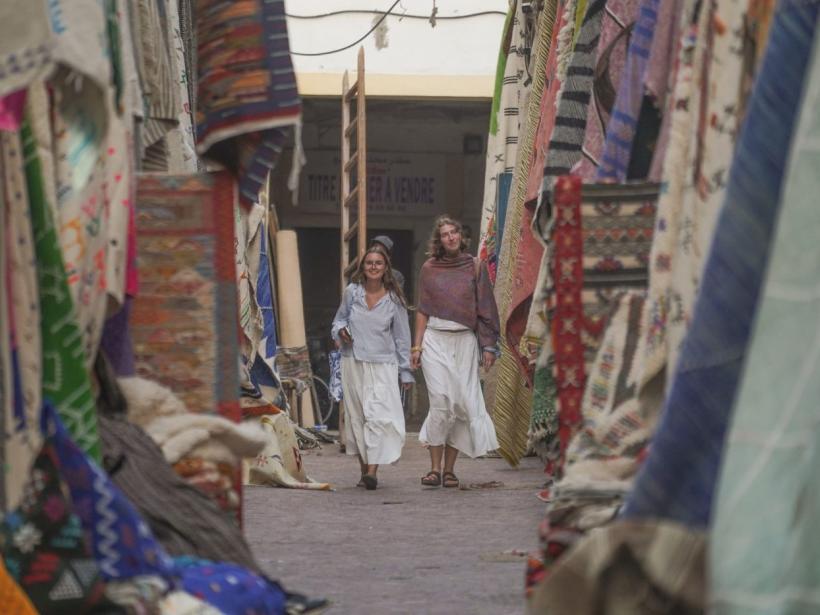
Photo: Msaidi Art, Pexels (Pexels License)