
Where can we get the best views of Paris for free?
The city’s finest panoramas often cost nothing. You can skip the paid observation decks and still capture the skyline from several elevated public spaces that are open daily.
The steps of the Sacré-Cœur Basilica in Montmartre offer a sweeping view from the north. Climb the hill just before sunset, when the stone facade warms in the light and the city spreads out toward the Eiffel Tower. The basilica itself is free to enter, and the dome ticket is optional.
- Sacré-Cœur steps, The terraced lawn and stairs in front of the basilica give you an unobstructed north-to-south vista. Bring a blanket and stay for the evening lights.
- Galeries Lafayette rooftop terrace, The department store on Boulevard Haussmann has a free open-air terrace on the eighth floor. You stand almost level with the Opera Garnier roof and see the Eiffel Tower framed by Haussmannian chimneys.
- Parc de Belleville, The highest park in the city, in the 20th arrondissement, slopes up to a wide belvedere. The view takes in the Eiffel Tower, the Montparnasse Tower and the rooftops of central Paris with far fewer visitors than Montmartre.
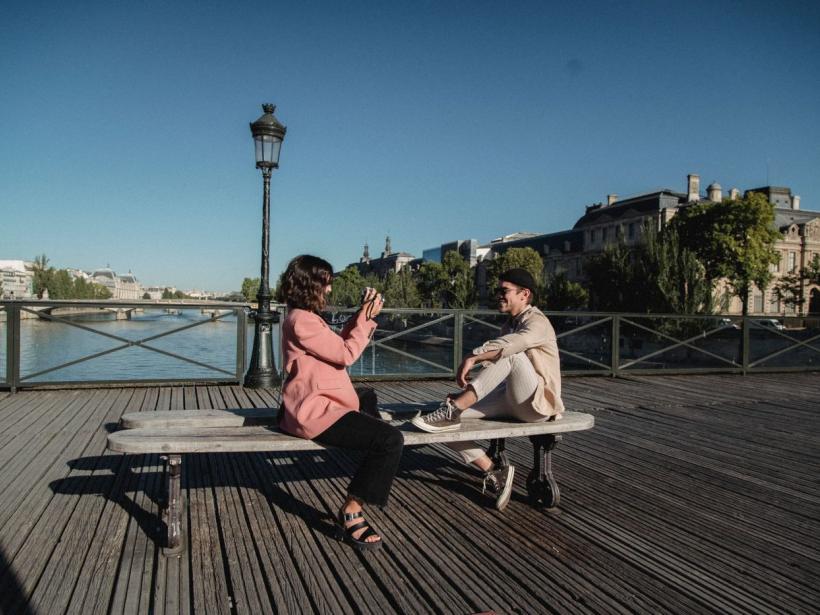
- Pont des Arts and Pont Neuf, Not elevated, but the low-angle river view from these bridges lines up the Institut de France, the Louvre and the tip of the Île de la Cité. Go after dark when the monuments are lit.
- Parc des Buttes-Chaumont, The temple-topped island in the lake sits on a steep cliff. From the belvedere path you see Montmartre and Sacré-Cœur across the northeast of the city, with a green foreground that hides the traffic.
Which romantic neighborhoods should we stay in on a budget?
The 10th, 11th, and 18th arrondissements give you the Paris atmosphere without the central hotel rates. The Canal Saint-Martin area in the 10th is a favorite for couples who want quiet morning walks along the water and easy access to the 5 and 7 metro lines. You will find small independent hotels and apartment rentals here for noticeably less than in the Marais.
Montmartre in the 18th arrondissement is more touristy but still has pockets of value, especially on the eastern side away from Sacré-Cœur. Look for rooms on rue Ramey or rue du Mont-Cenis, where you can walk to the vineyard at Clos Montmartre and reach central Paris on line 12 in under 20 minutes. The 11th arrondissement near Bastille and Oberkampf suits couples who prefer a lively food scene. Weekend markets on Boulevard Richard-Lenoir and dozens of affordable bistros make it easy to keep costs down, and lines 5, 9, and 2 connect you to the river in minutes.
How do we eat well in Paris without spending a fortune?
Step away from the main squares to eat well for less. The prix-fixe lunch menu, or formule déjeuner, lets you eat a two- or three-course meal at a proper bistro for a fraction of the dinner price. Most neighborhood restaurants post these menus on a chalkboard outside between noon and 2:30 p.m., and a full lunch rarely costs more than what you would pay for a single main course in the evening.
A picnic cuts costs dramatically and feels like the quintessential Parisian meal. Grab a baguette, cheese, pâté and fruit from a covered market like Marché Bastille or Marché des Enfants Rouges, then head to the banks of the Canal Saint-Martin or the lawns of Parc des Buttes-Chaumont. A bottle of wine from a corner caviste costs less than two glasses at a café terrace. Markets typically run two or three mornings a week, so check the local schedule the day before.
For dinner, seek out bistros in the 11th, 20th or 13th arrondissements, where rents are lower and cooking is often more personal. Look for a short, handwritten menu with five or six dishes rather than a laminated booklet with photos. A few streets back from any major boulevard, the prices drop and the tables fill with locals, not tour groups.
- Plan your main meal at lunch and order the formule with an entrée and plat or plat and dessert.
- Shop at neighborhood markets for picnic supplies instead of pre-made supermarket sandwiches.
- Avoid any café or bistro with a direct view of a famous monument; walk three blocks inland.
- Carry a reusable water bottle and ask for une carafe d’eau, which tap water restaurants must provide free by law.
- Check the chalkboard for the words fait maison, which indicate dishes prepared on the premises from raw ingredients.
- Buy pastries from a dedicated boulangerie rather than a sit-down café, where the same croissant costs double.
What is the cheapest way to get around the city?
Walking costs nothing and is often the fastest way across the centre. The central arrondissements are compact, and a stroll along the Seine from Notre-Dame to the Eiffel Tower takes about an hour. You skip ticket lines and discover quiet courtyards and book stalls that a metro ride hides.
For longer hops, the metro and bus network runs on a single ticket system. A book of ten t+ tickets, a carnet, cuts the per-ride price by roughly a third compared to buying singles. If your stay spans a Monday to Sunday and you arrive on a weekday, the Navigo Semaine weekly pass covers unlimited travel across all zones, including the airport train, and pays for itself after about five trips a day.
The Vélib' bike share suits a couple who want to move at their own pace. The standard bike is free for trips under 30 minutes, so you can pedal from the Marais to the Latin Quarter without spending a cent on transport. Electric bikes carry a small surcharge per ride. Grabbing a Vélib' after dark, when the streets thin out and the monuments light up, turns a simple route into a private tour of the city.
What does a realistic 3-day budget itinerary look like?
A three-day trip for two feels full and unhurried while keeping costs low. The plan below mixes free panoramic views, one paid museum, and meals from markets and neighborhood bistros rather than formal restaurants. You walk or use a carnet of metro tickets to keep transport costs to about €15 per person.
The total per person, excluding accommodation, comes to roughly €110 to €140. That covers food, one museum entry, a few metro rides, and a modest souvenir or coffee stop each day.
- Day one. Start at the free steps of Sacré-Coeur for a sunrise view over the rooftops. Walk downhill through Montmartre, pick up pastries and fruit at Rue Lepic market, and eat in Square Louise Michel. In the afternoon, explore the Marais on foot and end with a Seine sunset walk from Île Saint-Louis to Pont des Arts.
- Day two. Visit the Musée d'Orsay in the morning; book the first time slot online for €16 per person. A market lunch from Rue Cler (baguette, cheese, ham, a small bottle of wine) costs under €10. Spread it on the Champ de Mars lawn with the Eiffel Tower in sight. Spend the evening walking the Latin Quarter and finding a fixed-price bistro dinner for around €18.
- Day three. Browse the book stalls along the Seine and walk through the Jardin du Luxembourg. For lunch, try a crêpe from a street stand near Saint-Germain. Spend the afternoon in the covered passages near Grands Boulevards, then climb the free rooftop of Galeries Lafayette at dusk for a final city view.
Which paid attractions are actually worth the money for a couple?
Two paid experiences feel genuinely romantic without the tourist assembly line. The Musée Rodin charges €14 for access to its sculpture garden, where you can walk among The Thinker and The Gates of Hell under old trees. Buy a single ticket and share a bench by the pond; the garden alone is worth the fee, and the mansion interior is a bonus if you have time.
A late-evening Seine cruise with Vedettes du Pont Neuf costs €15 per person and runs until 22:30 in summer. The boat is less crowded after 21:00, and the Eiffel Tower sparkles on the hour once darkness falls. Sit on the open upper deck and skip the recorded commentary headphones. You get a front-row view of illuminated landmarks for less than the price of two cocktails in a Marais bar.
How can we avoid common tourist traps that inflate the bill?
Many of the steepest costs come from places that catch visitors off guard. The cafés clustered on Place du Tertre in Montmartre charge a premium for the view, often adding a seat surcharge you only notice on the receipt. Walk five minutes down the hill to Rue Lepic or Rue des Abbesses instead, where corner bistros serve the same café crème for half the price to a local crowd.
Restaurants with large, multilingual photo menus propped outside the door are another warning sign. These kitchens rarely cook to order and their fixed-price tourist menus hide low-quality ingredients. Eat where you see only a chalkboard menu in French and a lunch crowd of office workers. The difference in cost between a tourist brasserie on Boulevard Saint-Michel and a family-run boulangerie two streets back can be the price of a museum ticket.
Transport traps add up. A taxi from Charles de Gaulle into the city center runs to a flat fare of €55 or more, while the RER B train takes 35 minutes to Gare du Nord and costs just over €11 per person. At the airport, ignore unofficial drivers who approach you inside the terminal. Their cars are unlicensed and the final charge is never the number they quote at the start.
- Skip cafés on Place du Tertre and find a seat on Rue Lepic instead.
- Avoid any restaurant displaying a plastic-coated menu in six languages.
- Take the RER B train from the airport rather than a taxi.
- Ignore drivers who approach you inside the arrivals hall offering a ride.
- Buy bottled water at a supermarket, not from a street vendor near Notre-Dame or the Eiffel Tower.
- Check the small print for a "couvert" or bread charge before ordering at a formal brasserie.
Frequently asked questions
Is Paris really doable on a tight budget?
Yes. Many of the city's most romantic moments, like walking along the Seine at dusk or watching the Eiffel Tower sparkle from a park bench, cost nothing. With a little planning around food and transport you keep daily spending low without sacrificing the experience.
When is the cheapest time to visit Paris as a couple?
Mid-January through March and November, outside school holidays, see the lowest flight and hotel prices. The weather is cooler but the city is far less crowded, with shorter queues and more attentive service in restaurants.
Should we buy a museum pass or pay as we go?
Pay as you go unless you plan to visit three or more paid museums in two days. For a romantic budget trip, pick one museum you both care about and spend the rest of your time on free sights and wandering.
Is it safe to walk along the Seine at night?
Yes, the central quays between the Eiffel Tower and Île Saint-Louis are well lit and busy with locals and visitors until late. Stick to the upper quays after midnight and keep valuables out of sight as you would in any large city.
Photo: Bethany Ferr, Pexels (Pexels License)